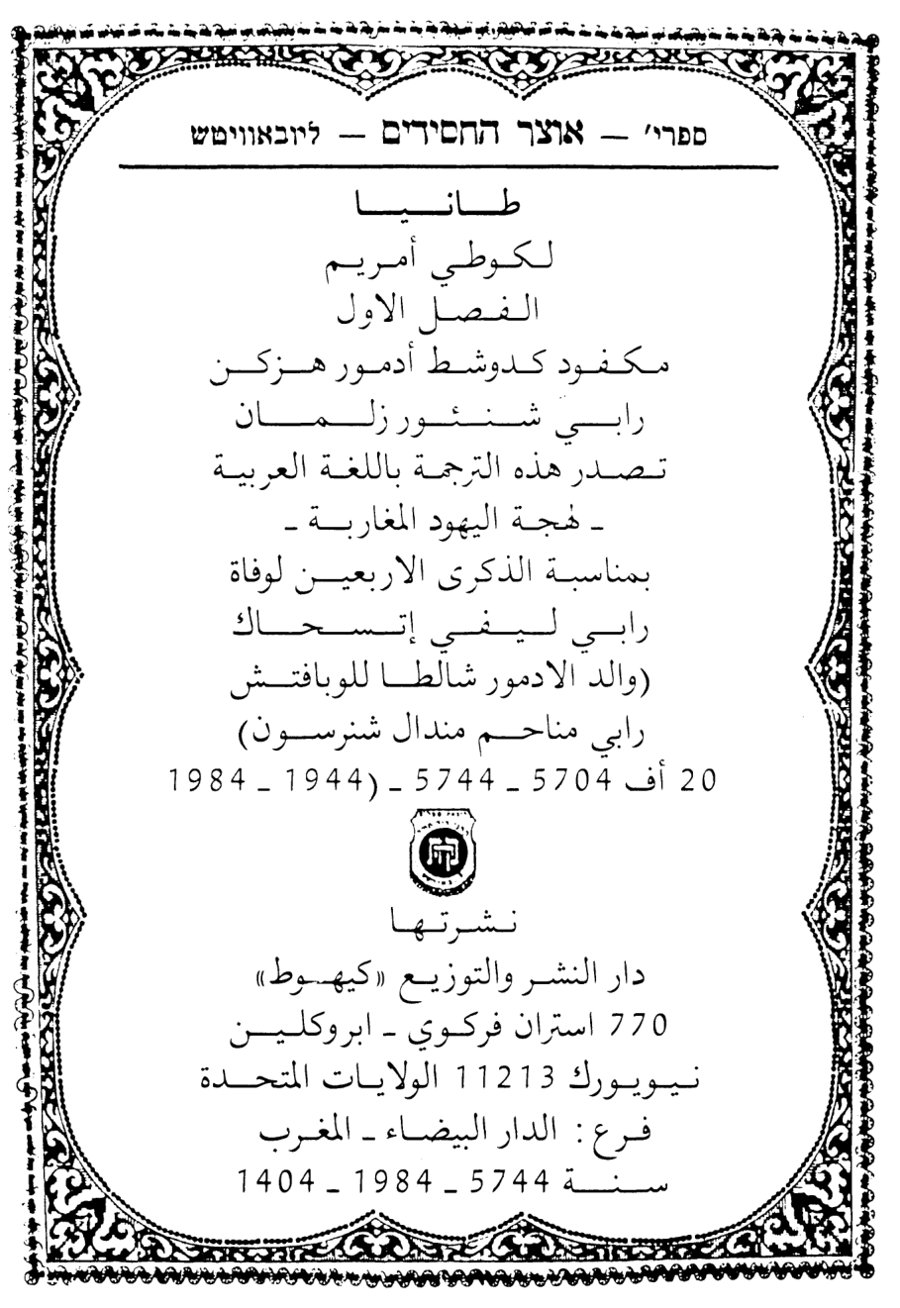
In the 1970s the Rebbe asked for the Tanya to be translated into Arabic. Rav David Buskila took it on, and presented his Judeo-Moroccan translation to the Rebbe on Yud Shevat 1980. We are completing the first full translation into Modern Standard Arabic, the language every Arabic reader understands.
It was Shabbos, soon after October 7th. My son and I were walking to shul in Beersheva. Far off, over Ofakim, we watched an Iron Dome interception burst across the sky.
He looked up at me.
“Tatty, why are they trying to kill us?”
It was a striking question, and I answered him as honestly as I could: “Because they don’t understand who we are.”
Then came the follow-up.
“So why don’t we teach them who we are?”
I didn’t have an answer for that one. Because the truth is, we can’t. Not yet. Chassidus, the deepest explanation of who we are as Jews, isn’t written in their language.
That question stayed with me the whole Shabbos.
It takes an ideology to defeat an ideology. And nothing can defeat Chassidus.
In the past three years, the Tanya has been printed in 57 places across Gaza, Lebanon and Syria, with great effort and expense, to elevate those places. That matters. But it left me with a simple question of my own:
What about the Tanya itself? Is there a Tanya in Arabic?
So I started searching.
A request from the Rebbe
What I found surprised me.
In the 1970s, Rabbi Leibel Raskin, the Rebbe’s shliach in Morocco, came to Rav David Buskila in Casablanca with a personal request from the Rebbe: translate the Tanya into sfas Yishmael, the language of Yishmael.
Rav Buskila hesitated. A translator, he knew, has to master both the subject and the language. So first the two of them sat and learned Tanya together, for many hours. Only then did he begin to translate.
He translated three parts of the Tanya into Judeo-Moroccan Arabic: Arabic written in Hebrew letters, much the way Yiddish is German written in Hebrew letters.
Then Rabbi Raskin told him the book should be brought to the Rebbe as a gift. On Yud Shevat 1980, they travelled from Casablanca to New York.
The Rebbe asked Rav Buskila whether he understood what he had accomplished by translating the Tanya into Arabic. And then he added:
“This translation will break the negative spiritual energy of Ishmael.”
Later, when Rav Buskila’s son came to the Rebbe with his kallah for a bracha before their wedding, the Rebbe told her that thanks to his father’s Arabic translation of the Tanya, we are hastening the Geulah: before Moshiach comes, the strength of Yishmael will be very strong, and we have to prepare.
Rav Buskila and his son tell the story in their own words:
Finding the book itself took longer. After a lot of research, I tracked down a copy.
Why Modern Standard Arabic
Then I was put in touch with Rav Yom Tov Gindi, a Syrian Jew living in Kfar Chabad. He had recently finished translating Rav Saadia Gaon into Arabic, so he knows this road well. His advice changed the plan.
He had a second piece of advice: since Rav Buskila’s translation was made at the Rebbe’s request, it should be the backbone of the new one.
And a word of caution. Arabic is a very complex language. Finding the right words for the deep concepts of Tanya and Chassidus has to be done with the utmost sensitivity and care.
That is exactly how we are doing it.
Why it matters
Spreading the wellsprings
Hafatzas hamaayanos: bringing the teachings of Chassidus to every place and every language.
ض
Elevating the language of Yishmael
Bringing holiness into the Arabic language itself by teaching Chassidus through it.
Breaking the negative forces of Yishmael
As the Rebbe explained, this work helps break the negative forces of Yishmael before the coming of Moshiach.
How the translation is made
1
Rav Buskila’s translation as the foundation Done
A copy of Rav Buskila’s Judeo-Moroccan translation was located, and it serves as the base of the work.
2
A glossary of concepts Done
Every key term is traced: how Rav Buskila rendered it, how the Rambam’s Guide for the Perplexed (written in Judeo-Arabic) used it, and how Arabic readers understand the word today. This shows what is missing, what is likely to be misunderstood, and what needs a careful explanation.
3
A first draft in Fusha, fully vowelized In progress
With the help of AI, a first draft with full vowel marks (tashkil) is under way.
4
Line-by-line expert review Needs funding
Jewish, Arabic-speaking scholars review the draft against the Hebrew to get every detail right. This is the heart of the budget.
5
Haskamos and a printed edition
The finished text goes to three Arabic-speaking shluchim for their haskamos, so that it can be printed.
Like the light of the sun within the sun
Shaar HaYichud VehaEmunah (the second part of the Tanya), chapter 6. First draft, awaiting expert review
But the Holy One, blessed be He, who brings everything into being from nothing: before Him, everything is utterly nullified, like the light of the sun within the sun.
From the explanatory note: the light of the sun, while it is still inside the sun, is not called anything at all, because it stands before its source. So too every created thing before its Creator, because its source is always present within it. Rav Buskila’s own rendering of the line: “He creates everything from nothing, and so everything is nullified before Him, as the sun’s light is nullified before the sun itself.”
Where the $60,000 goes
The goal covers the whole Tanya, all five parts: about 75,000 Hebrew words. Figures are estimates and will be updated as quotes come in.
Tap a line or the bar to see each part.
Total
$60,000
Questions
Is my donation tax-deductible?
Yes. Donations are processed through a registered 501(c)(3) nonprofit organization. A tax receipt is emailed to you right after you donate.
Can I donate anonymously?
Yes. Tick “Donate anonymously” and your name will not appear on the donor list. You will still receive your receipt.
Is my payment secure?
Payments are processed by Sola Payments (Cardknox), a PCI-compliant processor. Your card details go into secure fields hosted by the processor and never touch our servers.
Who is reviewing the translation?
Jewish, Arabic-speaking experts will review every line against the Hebrew. Their work is the largest part of the budget.
Why not translate into a spoken dialect?
Spoken Arabic differs from country to country. Modern Standard Arabic (Fusha) is understood by Arabic readers everywhere and is the language of all serious written work.